GRANULAR ACTIVATED CARBON TESTING SERVICES
FOR CLIENTS NATIONWIDE
Rapid Small Scale Column Tests (RSSCTs) scale down the conditions and dimensions of a full-scale filter bed with GAC and allow continuous flow (using client-provided water) until breakthrough of the granular activated carbon. This test was initially developed for evaluating organic compound removal on activated carbon. Bench scale setup is derived using hydrodynamics and mass transport equations, and has been shown to be very effective in indicating accurate breakthrough curves for granular activated carbon. Our granular activated carbon testing service allows you to compare the performance of several GACs for particular contaminants or predict the bed-life of a GAC in the full-scale facility. You can know your granular activated carbon usage rate and remaining filter/adsorber life in days, not months.
Engineering Performance Solutions uses the rapid small scale column test to predict months of full-scale data in days with very low water requirements. One particular area of concern in water treatment where RSSCTs can be useful is in the control of disinfection byproducts (DBPs). We can not only compare the removal efficiencies of DBP precursors, but effluents from the columns can be dosed with chlorine and the formation of trihalomethanes (THMs) and haloacetic acids (HAAs) monitored over time. With granular activated carbon testing, we can predict removal for any of the common contaminants listed to the right or design a custom test for your facility.
No matter your situation or activated carbon testing needs, our team will be there to help you. Give us a call today to learn more about our GAC testing services and to schedule an appointment!
Reliable GAC and Rapid Small-Scale Column Testing for TOC Removal Across the United States
Water utilities and industrial facilities across the United States often need to reduce Total Organic Carbon (TOC) levels in their treated water. Elevated TOC concentrations act as precursors to disinfection byproducts (DBPs) that form when organic matter reacts with chlorine during the treatment process. Granular activated carbon testing has emerged as one of the most dependable tools for addressing this challenge, offering facilities a proven, science-backed method for predicting contaminant removal before committing to full-scale operational changes.
The Science Behind Rapid Small-Scale Column Testing
Rapid Small Scale Column Testing services for the removal of Total Organic Carbon (TOC) work by scaling down the physical dimensions and hydraulic conditions of a full-size GAC filter bed. Using hydrodynamics and mass transport equations, these bench-scale setups generate breakthrough prediction curves that closely mirror what a full-scale system will produce over months of operation. The result is actionable performance data delivered in weeks, not months, with minimal source water requirements. For engineers and water treatment decision-makers, this approach eliminates guesswork at a fraction of the time and cost of field-scale evaluation.
The Science Behind Rapid Small-Scale Column Testing
Rapid Small Scale Column Testing services for the removal of Total Organic Carbon (TOC) work by scaling down the physical dimensions and hydraulic conditions of a full-size GAC filter bed. Using hydrodynamics and mass transport equations, these bench-scale setups generate breakthrough prediction curves that closely mirror what a full-scale system will produce over months of operation. The result is actionable performance data delivered in weeks, not months, with minimal source water requirements. For engineers and water treatment decision-makers, this approach eliminates guesswork at a fraction of the time and cost of field-scale evaluation.
Certified GAC Testing Services Designed Around Real Source Water Conditions
At Engineering Performance Solutions, our certified team provides GAC testing for TOC removal using client-provided source water and continuous-flow column setups designed to reflect real-world operating conditions. The bench-scale methodology we use has been validated for accurately predicting breakthrough curves across a broad range of contaminants. Our process allows facilities to compare the performance of multiple GAC media types side by side, so the right carbon is selected for the right application before any capital investment is made.
In addition to evaluating TOC removal performance, our column effluents can be dosed with chlorine to monitor trihalomethane (THM) and haloacetic acid (HAA) formation over time. This gives water utilities a complete picture of disinfection byproduct risk within a single, cohesive testing workflow.
What Our GAC Testing Evaluates
- PFAS (Per and Polyfluoroalkyl Substances), including long-chain compounds that bind effectively to the porous surface of activated carbon
- DBP Precursors, including Natural Organic Matter (NOM), Dissolved Organic Carbon (DOC), and Total Organic Carbon (TOC)
- Volatile Organic Compounds (VOCs) and semi-volatile compounds
- Pesticides and other regulated or emerging contaminants
- MIB and Geosmin
Custom test designs are also available for facilities with specific contaminant concerns not covered by standard panels.
How GAC Breakthrough Data Supports Capital Planning and Compliance Preparation
- Predict carbon bed life and establish replacement schedules with confidence
- Determine actual GAC usage rates ahead of full-scale system design or upgrade
- Select the most effective carbon media for specific source water chemistry
- Support PFAS removal compliance planning under current and evolving EPA standards
This data gives both municipal water treatment systems and industrial facilities a clear foundation for operational and infrastructure decisions.
Integrating GAC Testing into a Broader Water Quality and DBP Control Strategy
GAC testing delivers the most value when it is part of a broader lab water testing services strategy. Total Organic Carbon analysis, DBP formation potential testing, and trihalomethane monitoring all directly connect to the performance data generated by RSSCTs. Understanding how a specific carbon media performs under your actual source water conditions allows your facility to align treatment strategy with long-term regulatory and capital planning goals.
Connect With Our Certified Team to Schedule Your GAC Testing Consultation
If your facility needs reliable granular activated carbon testing or rapid small-scale column testing services for the removal of Total Organic Carbon (TOC), our team is ready to help. Contact us today to speak with a certified specialist and schedule your testing appointment.
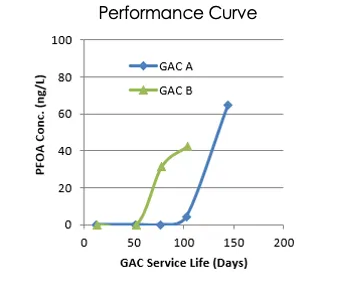
Breakthrough Prediction Curves
The column effluent breakthrough curves can help engineers and water utilities predict carbon usage rates and adsorber life for a number of emerging contaminants:
- PFAS
- DBP Precursors (i.e. NOM, DOC, TOC)
- VOCS & Semi Volatiles
- Pesticides
These breakthrough curves facilitate the selection of GAC media appropriate to the specific application and water condition.
Contact Us Today to Schedule GAC Testing!
Granular activated carbon (GAC) testing is becoming an increasingly popular and effective solution for reducing disinfection by-products (DBPs) and their precursors in water treatment processes. This method is particularly beneficial when implemented after sedimentation, as reduced natural organic matter (NOM) levels at this stage enhance GAC’s ability to lower Total Organic Carbon (TOC) concentrations. With its efficiency, GAC can maintain TOC levels well below desired thresholds for months before requiring replacement. In addition to targeting DBPs and VOCs, GAC has become a popular and effective option to target and remove PFAS (Per– and Polyfluoroalkyl Substances) compounds from water. The porous nature of activated carbon provides a large surface area, which is effective in trapping these compounds and removing long-chain PFAS from water. On top of its effectiveness, its ability to be regenerated makes GAC a sustainable and sensible choice for both municipal and industrial water treatment applications.
At Engineering Performance Solutions, our certified team specializes in Total Organic Carbon Analysis and GAC testing to help you achieve optimal water quality. Don’t wait to take the first step toward water testing consulting services.
Whether you prefer speaking directly with one of our specialists or filling out the contact form provided, we’re here to assist you with all your inquiries and scheduling needs. Contact our industry leading testing lab and consulting firm today!