PAC PERFORMANCE-BASED TESTING SERVICES
FOR CLIENTS NATIONWIDE
Our goal at EPS is to help the water treatment industry optimize its activated carbon selection by providing Performance Factors – developed specifically for each utility or company. These performance factors allow our customers to make an informed decision on activated carbon based on cost per unit of MIB (or other compound) removed, as opposed to cost per unit weight. In this industry, quality is more important than quantity, and a decision based on test results can save tens of thousands of dollars on activated carbon.
Activated carbon is specially processed to maximize its surface area to volume ratio through a multitude of small pores. This makes it particularly useful for filtering contaminants out of water. Powdered activated carbon, or PAC, is even finer, consisting of particles that have been ground or crushed. Many water treatment plants add it into the water supply at various points of the treatment process in order to control taste and odor. Not all PAC is created equal, however, which is where our professional activated carbon testing services come in.
Powdered Activated Carbon Testing for Taste, Odor, and Water Quality Challenges
Powdered activated carbon (PAC) is one of the most widely used treatment solutions for controlling seasonal taste and odor issues in drinking water. Utilities commonly apply PAC to remove 2-methylisoborneol (MIB) and geosmin, naturally occurring metabolites produced by algae and certain microorganisms. While these compounds do not pose a health risk, they create unpleasant earthy or musty tastes and odors that lead to customer complaints and reduce public confidence in drinking water.
Taste and odor events often occur during or following algae blooms and during the seasonal turnover of lakes and reservoirs. Because water quality conditions can change rapidly, utilities need a treatment strategy that is both effective and adaptable. Performance-based PAC testing allows operators to identify the most efficient carbon product before implementing treatment at full scale.
PAC Performance Testing for Cyanotoxins and Emerging Contaminants
In addition to nuisance taste and odor compounds, harmful algal blooms (HABs) can produce cyanotoxins that require monitoring and treatment. Depending on the species of cyanobacteria present, HABs may release toxins such as microcystin, cylindrospermopsin, anatoxin, and saxitoxins. Selecting the appropriate PAC s an important part of an effective treatment strategy, as different PAC products can vary significantly in their ability to remove these contaminants.
Engineering Performance Solutions provides performance-based PAC testing to help utilities evaluate activated carbon products under site-specific conditions using their own source water. By comparing removal efficiency and treatment costs, our testing helps utilities optimize chemical usage while meeting regulatory and operational objectives.
In addition to evaluating PAC performance for MIB and geosmin removal, EPS can perform testing for a wide variety of treatment challenges, including:
- Taste and odor compounds (MIB and geosmin)
- Cyanotoxins, including microcystin, cylindrospermopsin, anatoxin, and saxitoxins
- Total Organic Carbon (TOC)
- PFAS and other emerging contaminants
Every water source presents unique treatment challenges. Our performance-based testing provides data-driven recommendations that help utilities select the right activated carbon product for their specific water quality goals while maximizing treatment performance and controlling operating costs.
Performance Factors
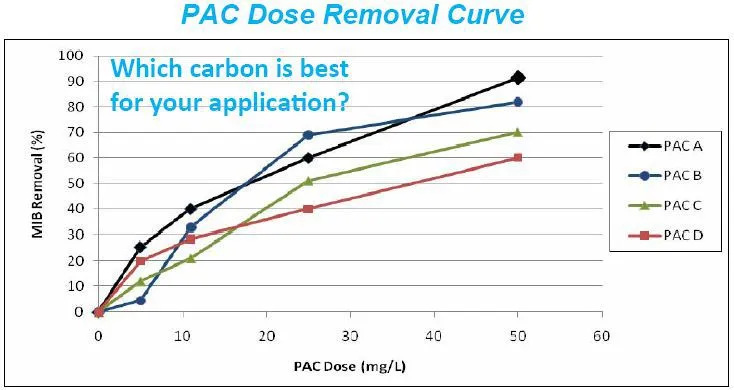
EPS will develop multi-point dose removal curves using several PACs for a contaminant of concern. This data allows clients to choose the optimum PAC for their application based on price and performance as well as predict doses needed to meet treatment objectives. As the figures below demonstrate, excessive amounts of money can be spent on treatment chemicals that were chosen based on price, without considering performance.
PAC Dose Removal Curve
Performance Factor Example
| PAC | Dose (mg/L) Required to Achieve 60% MIB Removal’ | Performance Factor | $/Ton | Adjusted $/Ton |
| A | 25 | 1.1 | 1300 | 1430 |
| B | 22 | 1.0 | 1360 | 1360 |
| C | 37 | 1.7 | 1450 | 2465 |
| D | 50 | 2.3 | 1160 | 2668 |
1 60 percent MIB removal was chosen for demonstration purposes only
A Performance Factor gives a “weighted ranking” for the treatment chemical being tested. The optimal chemical is scored as a 1.0, and the less efficient chemicals are scored in relationship to the best performer (always receiving a higher factor). Multiplying the Performance Factor by the treatment chemical cost provides a weighted cost that incorporates both performance and economics. Without performance factors, utilities might purchase Carbon D at $1160/ton, which appears to be a value, but because of its poor performance, actually costs much more ($2668/ton) to achieve the same results as Carbon B at $1360/ton. That’s almost half the cost!
EPS believes that performance-based testing is the optimum method for determining which activated carbon is best for the particular application. Therefore, EPS performs all performance-based tests with the customer’s carbons and water in order to best mimic the conditions of the full-scale facility. Proper performance-based testing can alleviate overspending on treatment chemicals and help ensure all treatment goals are met.
Ready to learn more? Contact us below if you have questions or if you’re ready to get started.