
Authors: Kaitlyn Rullo; Christine Valcarce
Arsenic in the New England Region
Arsenic is a naturally occurring metalloid commonly found in groundwater due to the natural breakdown of local minerals. Anthropogenic sources of arsenic can come from runoff due to mining, pesticide application, and manufacturing activities.
Arsenic concentrations can vary geographically, even in the same aquifer system, due to weathering of limestone and rocks, where over time, the pH of the groundwater gradually increases (Ayotte et al., 2003). This shift to basic pH will cause arsenic to desorb from the sediment and become more mobile in the groundwater, leading to potential risks for the drinking water industry due to the adverse health effects attributed with arsenic exposure.
The Environmental Protection Agency (EPA) has set the arsenic MCL at 10 ug/L with an MCL goal of zero. Most New England states follow the EPA MCL, with the exception of New Hampshire, which established their regulatory level at 5 ug/L (Hooper et al., 2020).
Removing Arsenic from Drinking Water
Water treatment options for targeting arsenic include:
- Ion exchange
- Sorbent Filters
- Coagulation
- Membrane Technologies
Sorbent filters use adsorptive media, such as activated alumina, silica gel, zeolites, and activated carbon, to remove arsenic via absorption mechanisms (Gu et al., 2005) and are a proven reliable and cost effective technology in water treatment.
Activated carbon, being versatile at removing co-contaminants such as TOC and PFAS, offer flexibility and reassurance. Since activated carbon performance will depend on a complex set of factors, such as the target pollutant concentration, background competition, ionic strength, pH, pore size distribution, and adsorption active sites, it is recommended that pilot or bench scale optimization studies are conducted with the source water (Gu et al., 2005). Selecting the most efficient activated carbon product to each specific source water reduces the risk of adverse performance during long-term operation. Furthermore, because water source quality and activated carbon production can change overtime, we advocated filter efficacy studies with each procurement contract cycle as a way of ascertaining continued operational optimization.
An Emerging Twist of Fate
In recent years, activated carbon has been heavily studied for its performance at removing PFAS and has become a popular technology choice for New England utilities, especially in Massachusetts and Connecticut. As utilities proceed with their permitting process of implementing full-scale GAC adsorbers in preparation for regulatory enforcement, an emerging problem has come to light: arsenic will leach out of some GAC products, particularly during initial startup of the GAC bed.
The amount of arsenic that may leach out depends widely on the GAC source material, the pH and the ionic strength of the source water. The knowledge that GACs may contain impurities that contaminate the drinking water is not new. The drinking water and activated carbon community have a few standard methods for quantifying impurities from activated carbon. For instance, the ASTM D28 committee have a standard method D5029 for quantifying the total amount of water-soluble impurities that may leach off a carbon product (ASTM International, 2020). NSF (2016), the Food Chemical Codex (2018), and the European Committee for Standardization (2009) have all adopted similar versions for quantifying impurities. While the methods can easily be modified (if need be) to test specifically for arsenic, the shortfall to most of the methods is the use of deionized (DI) water or a synthetic water “recipe” as a substitute for the source water. Thus, none of these methods can truly quantify the extent of the problem a utility might face during the GAC startup cycle. Unintentionally, figuring out if arsenic will be a problem and how to deal with it has become a surprising twist and operational challenge.
During startup, pH excursions often occur until the GAC has been sufficiently conditioned with the source water and reach an equilibrium. Similar to sediment affinity in the aquifer, the temporary rise in pH will cause any inherent arsenic in the GAC to desorb into the water. As a result, activated carbon manufacturers have started acid washing their products to remove arsenic impurities and to further reduce the initial pH flux during conditioning. It is worth noting here that the impact of acid washing the GAC needs to be evaluated for target contaminant removal (i.e. PFAS) in comparison to the non-acid washed GAC through RSSCT or pilot evaluation so that a holistic decision on GAC product can be made.
GAC Conditioning Simulations
Typically, when GAC is placed in service, the product must be fully wetted to remove entrapped air and rinsed to remove fines and stabilize the pH. Beyond that, any additional specifications for conditioning may be set by the manufacturer and/or state or local permitting authorities. For instance, a plan for properly handling the discharge from the conditioning and backwash procedures should adhere to local regulations (MassDEP, 2026).
The potential impact of arsenic in the conditioning discharge has created uncertainties for utilities to navigate such as: 1) what concentrations of arsenic will leach out, and 2) how long to condition before arsenic reaches safe drinking water levels. Knowing this will help determine the volume of waste to handle for discharge.
Engineering Performance Solutions partners with utilities to provide data driven solutions through filter efficacy studies that simulate operational conditions. To this extent there are a few different methods for evaluating arsenic during GAC startup:
- Performing a standardized test for measuring extractable arsenic using the utility source water as a substitute for DI or synthetic water recipe.
- Custom soak tests (with utility source water) that will mimic the wetting and backwash procedures during GAC placement.
- Forward rinse simulations to 100 bed volumes (BVs) while monitoring arsenic at regular intervals.
Each subsequent test requires more of the utility source water. For instance, an arsenic extraction test can be performed with as little as 200 ml of water per GAC product. A soak test can be performed with about 2 L of water per GAC, but the forward rinse simulation will require about 10 gallons of water per GAC.
A simple arsenic extraction test is a cost-effective strategy for evaluating if arsenic will be a problem. For instance, comparing 6 different wells from the same well field with pH 7.7 – 7.9, Figure 1 shows that each well behaved differently in how much arsenic was extracted from the GACs. Interestingly, if the test was performed per the standard method, with only DI, then GAC 1 would have appeared to be in compliance with the EPA MCL. By contrast, using the source water and evaluating different wells, it is evident that arsenic will be a problem during startup with either GAC product chosen.
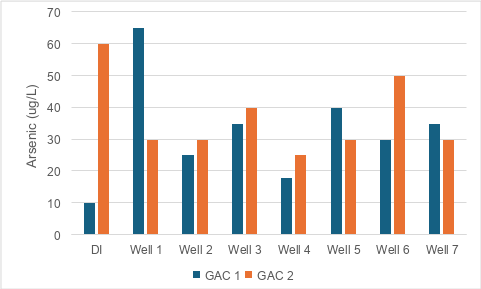
Figure 1: Arsenic extraction test to compare 2 GAC products across different wells
Once arsenic is a known concern for the site, the next iteration of testing can include a soak, agitate, and decant procedure similar to backwashing (Figure 2), or a forward rinse column test (Figure 3) to determine the BVs necessary to flush the arsenic from the GAC. The soak test can be especially useful during GAC changeouts to determine if a problem will persist (or arise) with reactivated GACs from changes in carbon pore structure during the reactivation process.
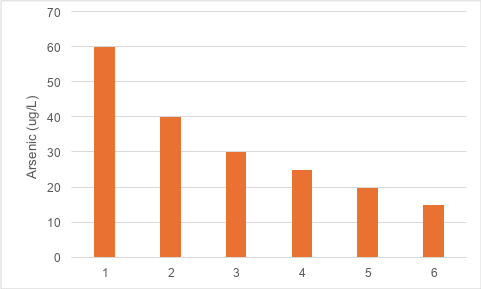
Figure 2. GAC was soaked for an initial 24 hour period at a 70:30 GAC:water ratio similar to pressure vessel scenarios with subsequent fill and decant cycles to approximate the number of flushes necessary to remove arsenic.
Column tests, on the other hand, are important full-scale simulation to consider when utilities are faced with deciding if to use a non-acid washed GAC or an acid-washed GAC. Figure 3 shows that acid washing the carbon drastically mitigated the initial arsenic concentration, but both GACs required similar BV to rinse the arsenic to steady state conditions. Since an acid-washed product is likely to cost more on a per pound basis than the non-acid washed GAC due to the extra processing required during manufacturing; complementing the utility’s decision matrix with an RSSCT to look at long-term performance for the target contaminant (i.e. PFAS) can help them make a cost-effective and holistic data-driven decision.
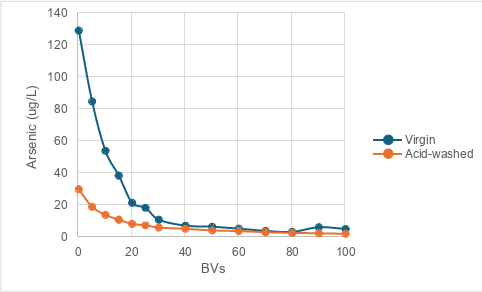
Figure 3. A column study conducted using the utility source water with the virgin GAC and its acid-washed counterpart to determine the total bed volumes necessary for arsenic to baseline.
References
ASTM International. (2020). Standard test method for water solubles in activated carbon (ASTM D5029‑98[2020]) . https://doi.org/10.1520/D5029-98R20
Ayotte, Joseph D., et al. “Arsenic in groundwater in eastern New England: occurrence, controls, and human health implications.” Environmental Science & Technology, vol. 37, no. 10, 9 Apr. 2003, pp. 2075–2083, https://doi.org/10.1021/es026211g.
European Committee for Standardization. (2009). EN 12915‑1: Products used for the treatment of water intended for human consumption — Granular activated carbon — Part 1: Virgin granular activated carbon.
Food Chemicals Codex. 2018. Appendix III: Chemical Tests and Determinations. Food Chemicals Codex. https://doi.org/10.31003/FCC_Fl 00294_06_01
Gu, Z., Fang, J., & Deng, B. (2005). “Preparation and evaluation of GAC-based iron-containing adsorbents for arsenic removal”. Environmental Science & Technology, 39(10), 3833–3843. https://doi.org/10.1021/es048179r.
Hooper, L.; Susca, P.; Rigrod, P.; (Fall 2020). Supply Lines with the Source. New Hampshire Department of Environmental Services.
MassDEP. (January 2026). “Guidelines for Public Water Systems Chapter 5: Treatment”. Guidelines for Public Water Systems | Mass.gov.
NSF International. (2016). NSF/ANSI 61: Drinking water system components – Health effects.
About the authors: Kaitlyn and Christine work at Engineering Performance Solutions (EPS) as lab manager and director respectively. We pride ourselves in working closely with clients to provide testing services that lead to data-driven solutions. We specialize in testing activated carbon to help engineering firms and utilities find cost-effective products and designs that optimize operations and efficiency.