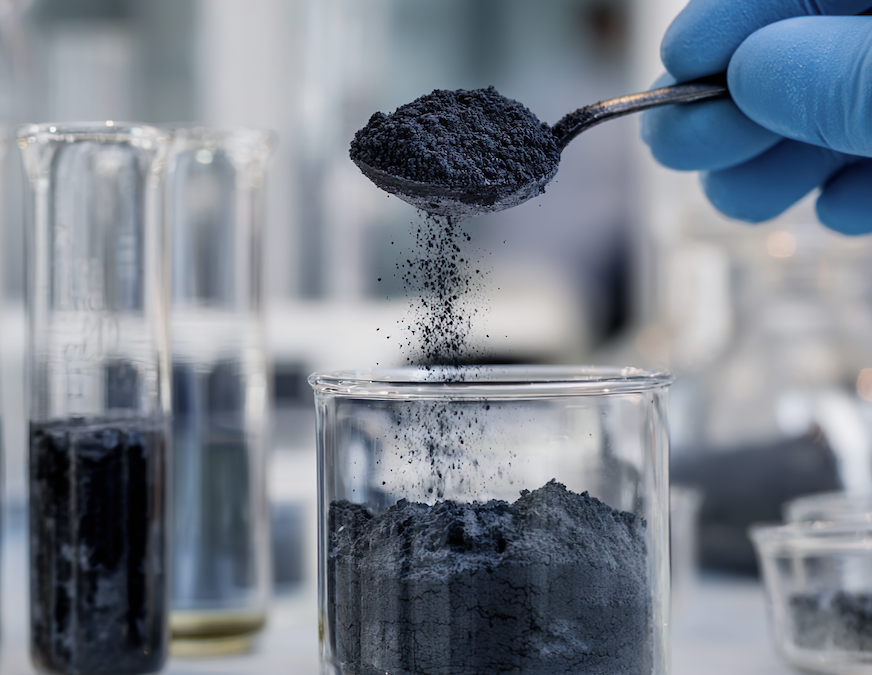
Activated carbon is widely used in the water treatment industry to adsorb a wide array of contaminants. There are many sources of activated carbon material, and each type of activated carbon may perform differently depending on the source water. Jar Tests, also commonly referred to as Performance Tests (PTs), are a way to quickly test the effectiveness of activated carbons’ ability to remove contaminants in water, while simulating the treatment process of the utility.
- Common contaminants clients often test are for:
- Methyl-isoborneol (MIB)
- Geosmin
- Per- and Polyfluoroalkyl substances (PFAS)
- Total Organic Carbon (TOC)
- Microcystin-LR
- Cylindrospermopsin
- Anatoxin-a
Engineering Performance Solutions Services
Dose-Removal Curves
Engineering Performance Solutions (EPS) is the industry-leading performance-based testing provider for powdered and granular activated carbon products. These performance tests, following AWWA Standard B600-10 Appendix B, allow for clients to test different concentrations of powdered activated carbon (PAC) with their specific source water to target contaminants without having to send large quantities of water or carbon. Utilizing the customized treatment objectives, EPS will create dose-removal curves for the contaminants of concern. Figure 1 illustrates a dose-removal curve for MIB for six PACs. Performance of the PACs may be heavily impacted by the source waters due to the high variability of sources waters and the seasonal changes they face. For the project shown in Figure 1, PAC E was an optimal remover in comparison to the other PACs. Dose-removal curves provide a graphical representation to easily compare each PAC at specific doses and provides a performance metric for the chosen product that can guide operators to adjust feed rates based on treatment goals.
PAC Performance Factors
Performance factors are weighted rankings for the media being tested. The optimal media is scored as 1.0, and the less efficient media is scored in relationship to the best performer (always receiving a higher factor). Performance factors provide utilities with a weighted cost comparison per media. This helps utilities compare media directly from a cost perspective as they can take that performance factor and multiply it by the cost of the media. For example, as PAC E was the best performer it has a performance factor of 1.0 and say its $1400 per ton, but PAC B is only $700 per ton but it has a performance factor of 3.3. That makes the weighted cost of PAC E $1400 per ton and PAC B $2310 per ton (Table 1) to remove the same amount of MIB. So, performance testing will help utilities make more informed financial decisions.
Table 1. Performance Factors to Meet 50% MIB Removal
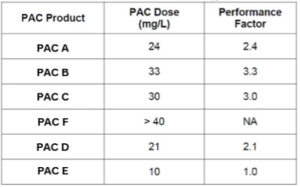
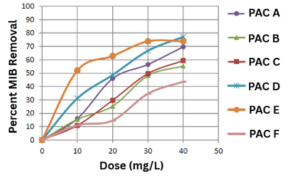
Figure 1. MIB Dose-Removal Curves Case Study
Conclusion
Performance testing can be used for a wide array of contaminants so it can be tailored to the needs of the utility with specific concerns. It is also important to note that PTs are a time stamp of seasonal variances. Source waters may also change with seasons as well; thus it is important to test the water routinely to understand its makeup and predict seasonal spikes before they happen or get overwhelming to manage. Routine testing can help prevent surprises and save utilities money in the long run, while maintaining consumer trust in their drinking water.